
I’m just recently back from New York, where I spent three days lecturing as part of ClickerExpo, an annual conference organized by Karen Pryor Clicker Training.
This year, I gave two lectures at the conference. In addition, I presented two learning labs and participated in a symposium about multiple markers. It was a busy weekend!
As I mentioned in last week’s blog post, Chewie didn’t get to come with me to the conference. But, she certainly did help me prepare for the conference.
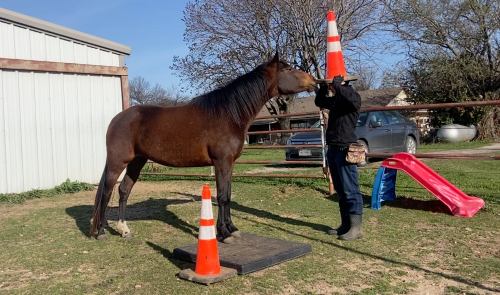
In today’s post, I want to explain more about the photo I shared last week with the cone on my head.
One of my lectures at ClickerExpo this year was all about cues. I discussed what cues are and how they work. I also talked about the idea of “constant stimuli” and how constant stimuli work in conjunction with cues.
What is a constant stimuli?
When an individual learns a behavior, they don’t just learn the behavior. The individual is also learning the antecedents (cues) that accompany this behavior, as well as the constant stimuli.
You can think of constant stimuli as the context, or the background features. They are the features that are constants during a training session. We usually don’t even notice them! However, when they change suddenly, they can disrupt a behavior.
As part of my lecture, I showed some video examples illustrating how constant stimuli may disrupt behavior, what we can do to prevent these disruptions, and how we can use constant stimuli to create stronger cues.
Chewie has a very solid behavior which involves standing with two feet on a platform.
She approaches the platform from a distance, climbs onto it, and then stays on it until I give my reinforcer signal. When I say the word “nice” (my reinforcer signal), we both leave the platform, and she receives a handful of pellets in a large tub that is located some distance behind the platform.
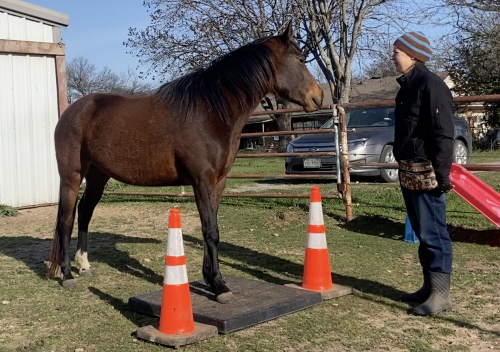
I often put two cones on either side of the platform. The cones don’t cue the behavior. But, they are usually present. They become part of the constant stimuli, or background features of this training set up.
However, the cones are always on the ground!
I was curious to see what Chewie would do if I altered the constant stimuli for this training set up. What if one of the cones was on top of my head, rather than on the ground?
Chewie had no problem getting on the platform.
She approached the platform promptly and climbed on it, as she always does. However, as you can see from the photo below, Chewie was quite curious about the cone on my head! She spent quite a bit of time smelling the cone, even though she has seen this same cone on the ground many, many times.
One way you can strengthen your cues is by making frequent changes to the constant stimuli. Animal trainers sometimes call this process “proofing.” Your animal is learning to perform the behavior on cue, with lots of variations in the background environment.
Your goal during this process should be to make gradual, systematic changes that result in the animal still performing the behavior reliably on cue.
When I put the cone on my head, I made too big of a change. Even though Chewie successfully got on the platform, her behavior was disrupted. She was not ready for the next cue and needed a good bit of time to check out the cone on my head.
I could have made this training session even more successful by starting with gradual changes. For example, over a series of repetitions, I could have put the cone on a cinder block, then held it at waist height, then held it at chest height, and so on, gradually raising the cone until it was on my head.
However, I loved that Chewie was super curious about the cone and wanted to smell it. She was not at all scared or uncertain about a person with a cone on their head!
No comments yet.