
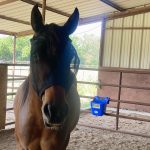
Last week, I wrote about introducing Chewie to a fly mask. This week, Chewie and I have continued to practice putting on and taking off the fly mask.
In this week’s post, I wanted to share a video with you of our current fly mask routine, as well as some big ideas that I have been thinking about.
In the video, you will see the predictable routine that we have established and that I now use each time I put on the mask. You’ll see that Chewie starts the routine by coming over and touching the mask. Then, she earns several clicks and treats throughout the routine.
Watch on YouTube: Chewie’s Fly Mask Routine
Here are some big lessons that have helped us establish a successful routine with the fly mask.
Big idea #1: Predictable routines create more opportunities for “yes” and “no”
We’ve established a predictable routine with the fly mask. I always start the sequence in the same way. And, I use the same steps each time, in the same order.
Having a predictable routine makes it easier for me to see when Chewie is saying “yes” and when she is saying “no.” Of course, Chewie can’t actually talk to me, but she communicates very clearly through her behavior!
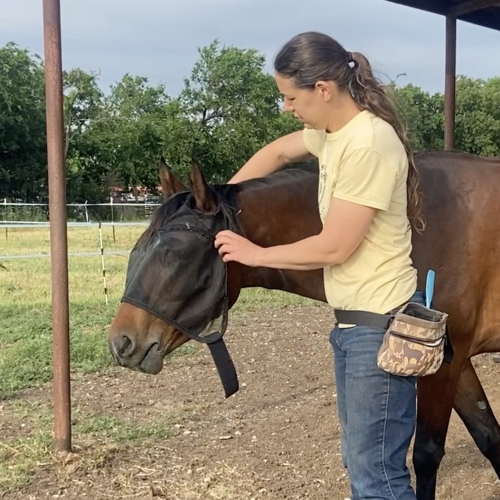
As part of this routine, Chewie has two opportunities to approach me. At the very beginning, she starts the routine by coming over and touching the fly mask with her nose. Then, after the first click and treat, I walk several steps forward, giving her a second chance to approach me.
At both of these points in the routine, I’m checking to see if she willingly and eagerly approaches.
In addition, Chewie is loose in the barn (no halter or lead rope) and the gate is open. So, she can leave at any time, if she wants.
Having a predictable routine helps me notice signs that Chewie may be concerned or unhappy, such as hesitating to approach me, turning her head away, backing up, or tense body language.
Big idea #2: What adjustments can make our interactions even smoother?
I video almost all of my training sessions. Watching the videos allows me to assess what’s working well, what is almost working, and what’s not working.
When we first started practicing with the fly mask, I could tell that Chewie was sometimes unhappy with me lifting the mask over her eyes and putting her right ear in the mask.
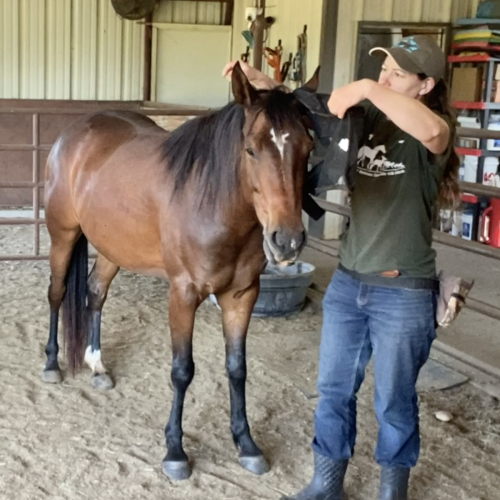
I have been experimenting with different ways of initially placing the mask on Chewie’s head or neck. I’ve found that it is easier for her if we start with the mask on her neck and then swing it around. I’ve also been experimenting with different ways to hold the mask and move the mask as I bring it over her eyes.
I haven’t tried to teach Chewie to tolerant these parts of the routine or tried to reinforce her for keeping her head straight. Instead, I’ve tried to find adjustments that I could make to my behavior that would help her be comfortable and happy.
Whenever I’m training, I’m always looking for adjustments, big or small, that will help the animal and I be more successful together.
Big idea #3: Don’t be greedy with your reinforcers!
I find many horse trainers, dog trainers, and pet owners are eager to reduce or eliminate the treats once the animal “knows” the behavior.
Our current fly mask routine takes about one minute, and Chewie earns four clicks and treats.
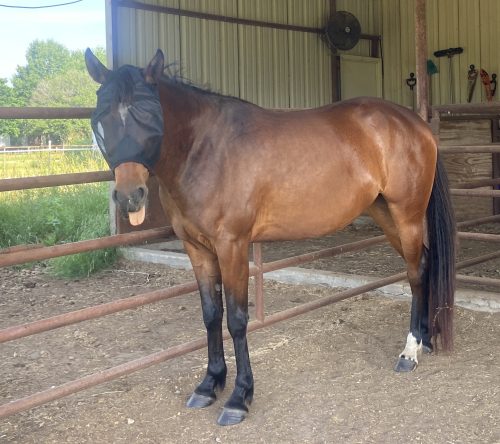
Long term, I may work toward having this function as a longer chain of behaviors, with one click and treat at the end.
But, for now, I feel like Chewie and I are both happy with our current routine. I love that Chewie is eager to participate and comes right over when I hold out the fly mask each time.
So, why try to fade out the treats? I think it’s perfectly fine that we are breaking the fly mask routine into several steps and that Chewie earns a click and treat for each step.
No comments yet.