
Chewie has fully recovered from being sick and is happily participating in all of her normal daily activities again. However, I have still been going to the barn twice a day, as she finishes up her antibiotics.
I thought it might be interesting to try some short training sessions in the evening. Before this week, I don’t think Chewie and I had ever done any training in the dark!
I was curious to see how Chewie would do.
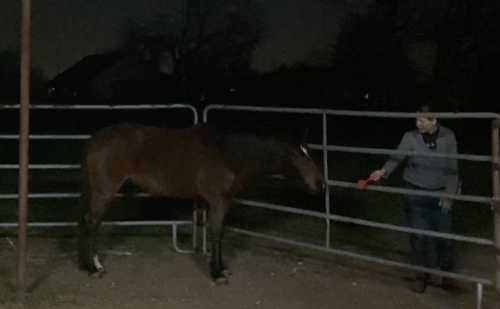
I stuck to cues and behaviors that Chewie knows well, and she responded easily.
But, I could tell that the training was a little harder for both her and for me. Sometimes, she was a little slower to respond. As well, she sometimes was just a little grabby when taking food from my hand. Usually, she is very gentle.
I realized that a lot of things were different for both of us.
Of course, everything was darker. It was harder for me to see what Chewie was doing, and I’m sure it was also harder for her to see my movements. In addition, we had different sounds in the background, and I imagine that nighttime may also smell different for Chewie.
All of this got me thinking a lot about the conditions that are typically present when Chewie and I do our training sessions. These conditions include the time of day, where we are on the property, weather, events happening the background, and a whole range of sounds and smells.
There are some of these variables that are often different. However, others of these variables are usually constant.
Long term, I want to make sure that Chewie’s training will transfer to a wide variety of conditions. For example, in an emergency, she may have to get on a trailer in the dark. Or, on a hot Texas summer day, I may want to do some training at night when it is a little cooler!
Going forward, I’m going to be thinking more about our typical training conditions. Then, we can start to systematically transfer Chewie’s training to some of our not-so-typical training conditions.
No comments yet.