
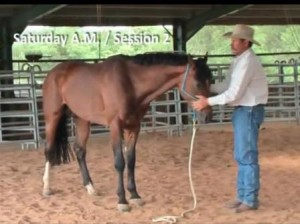
The latest gossip on the internet is all about Pat Parelli’s recent demonstration with a stallion named Catwalk. If you haven’t heard, I’ll catch you up briefly.
Catwalk is a show jumping horse who is extremely difficult to bridle. Over the course of the weekend Pat Parelli worked with Catwalk until he could be bridled. However, from eyewitness accounts, the demonstration got a bit too rodeo at times, with ropes used as lip twitches, legs tied up, Catwalk rearing and struggling to get away and spectators walking out in disgust.
I wasn’t there.
I didn’t see the horse or the demonstration. I don’t know how “extreme” the horse’s problems were or if simpler methods were tried first. I don’t know if the results will last or if other problems were created.
However, the incident with Pat Parelli and Catwalk does bring up many questions about how “extreme” behavior issues should be handled when training horses. Here are 5 important lessons that we should be reminded of after the fiasco with Parelli and Catwalk.
1) There are no problem horses
There are no problem horses or extreme horses. Just horses that have problems with people and a few who have extreme problems with people. Most horses are perfectly happy in the pasture. It’s when people get involved that the problems start.
When a horse acts up or misbehaves he is acting with his safety and comfort in mind. His actions don’t seem extreme to him.
Horsemanship is about seeking partnership. We have to try to find ways to work with the horse, rather than fighting against him. We need to find training methods that help the horse to look to us for guidance, rather than seeing us as part of the problem.
2) Choose Conditions that are Ideal for Learning
Setting, location, distractions, structure of the lesson, these can all make or break a training session.
Now imagine putting a horse in a new location, without other horses around, with bright lights, strange loud noises and a cheering crowd. This would put most horses on edge and not in a learning frame of mind.
When we train, we need to consider the best conditions and environment that will help the horse learn and progress. If conditions aren’t ideal, sometimes we might need to help the horse be comfortable in those conditions, before we start training something new.
Also, we must consider session length and structure. Many times progress will be much quicker if we work in short sessions or intersperse training something new with working on behaviors that have already been established.
3) Is horse or human safety at risk?
Will the horse or human will be in danger if the problem is not fixed right now? Sometimes it is appropriate to use “extreme” or “harsh” methods in order to get something done, such as providing medical treatment to an injured but uncooperative horse.
There is no reason to use excessive force to “get it done now” for issues such as bridling. The time frame to conquer Catwalk’s issues in a weekend was arbitrarily set by Pat Parelli.
Most of the time, there are thousands of ways to address a problem. We need to be open to a variety of solutions and techniques and start with the ones that will be the safest and the most easy for the horse to understand.
If we are constantly fighting with the horse or not making progress, it’s time to try something new. Or, it might be time to take a break, let horse and human cool off and then start again from a more calm and relaxed state. If we act like we have all the time in the world, training actually often progresses faster.
4) Any Piece of Equipment can be Abusive
Any piece of equipment in the wrong hands can become a torture device. Much of the buzz about the incident with Catwalk is about the specific techniques and pieces of equipment that Parelli used. Lip chains, hobbles, tying up a horse’s leg, laying down a horse, gag bits, spade bits, whips…many pieces of horse tack resemble medieval torturing devices.
We are quick to blame the piece of equipment and fault the trainer for using such a device or tactic.
However, in unskilled hands, even a snaffle bit or a halter can become a torture device. So, rather than debating whether certain techniques or pieces of equipment should ever be used, I think it is more important to see how that equipment is being used and the skill or technique of the person using it.
A highly trained bridle horse is probably much more comfortable wearing a spade bit than a lesson pony in a snaffle who is being popped in the mouth over every jump by a beginner rider.
Was Pat Parelli wrong to use the equipment or techniques he used? I wasn’t there, I don’t know. However, the incident with Catwalk is a good reminder that we should strive to find the most humane techniques and equipment available. Then, we must become skilled in our mechanics and timing so we can be gentle and humane in applying the techniques and methods we choose.
5) Are we Focused on Results or the Training Process?
The demonstration with Catwalk was all about getting the bridle on the horse. This was the final goal. And, from the clips I saw, it was achieved.
But at what cost?
Will Catwalk regress back to old behavior patterns in the future?
Does Catwalk trust Pat Parelli and view him as a friend?
Were principles and the horse’s welfare sacrificed during the training?
Often, when we focus on single problems or goals, we miss the bigger holes. We can make it all about the bridle, like Parelli did with Catwalk. Often, though, we might need to go pretty far back in a horse’s foundation to find the real problem.
From the clips I saw, the horse wanted nothing to do with having his ears or face touched. How about working through that first until the horse enjoys having his face touched? It might take more than a weekend.
It’s harder to teach a horse to like something when you have an “I’m going to MAKE you do it attitude.” The problem is, we often get our horses to tolerate things, but don’t go far enough to teaching them to like it.
Rather than focusing on the bridle, start with ground work and the basics. Instead of starting with the scary and uncomfortable, start by establishing communication and understanding with the horse. Get the horse calm and relaxed and thinking of you as a friend.
Only return to the bridle when you are working with the horse, rather than against him.
Readers, I would be interested to hear your comments and input on this incident and thoughts in general on trainers working with extreme behavioral issues.
Very thoughtful post. I think sometimes these big arena events, where a troubled horse – who probably has a lot more issues than just bridling – is subjected to tight time deadlines are a mistake. Every horse is different, and every horse needs to be handled with respect and fairness – even a horse with extreme issues. Inability to bridle can be worked around and addressed – starting with what the horse will willingly accept – say, touching the neck – and working from there in appropriate length sessions – not forcing things to a conclusion. As you say, it may be necessary to use force in an emergency, and sometimes it’s necessary to get big to protect yourself, but otherwise coercion is just coercion – it’s not training.
Great points, Kate.
I like that you said “coercion is just coercion – it’s not training”
So true. In situations like this the horse learns often nothing other than that he must submit.
Mary
Well when it comes too horse training.. he was doing exactly what you should do, and yes it can seem abussive but it’s not.. you do NOT give in too what the horse does and doesn’t want to do when your working with him, you start gentle and gradually apply pressure till he relizes what you want him to do, if he doesn’t want to do it, you keep working on it till he does it, letting a horse go before he does what you ask him, will teach him that he can get away with it, and the result can become dangerous especially with stallions, and they can kill you!! I own stallions and i know sometimes you have to be rough or you’ll get seriously injured, cetching the foot is part of keeping control. persistence is everything in horse training. and if you think thats rough, look how horses treat each other.. they aint exactly sweet as honey..
Hi Shamus,
Thanks for leaving a comment on my blog.
I really hope that you’ll consider sticking around and reading some of the other posts, especially some of my adventures starting and re-training rescued horses.
I use positive reinforcement-based training when working with our horses. What I’ve found and what others have found with these kinds of methods is that training does not have to involve forcing the horse, being rough, increasing the pressure, or convincing the horse “who’s the boss.”
I believe that if my horse understands what I am asking, knows how to do it, and is confident doing it, then he’ll do it! If the horse refuses or says “no,” to me this is a problem with the training, not with the horse. So, I figure out which of these three parts is missing: communication, ability to do the behavior, or confidence. Then, it’s my job to set up a training situation so that the horse can learn how to do the skill successfully and will be able to do it next time I ask.
If you’re interested in more information about this kind of training, I recommend checking out Karen Pryor’s book Don’t Shoot the Dog, or Sharon Foley’s book Getting to Yes. I have reviews of both of these books on my
site here:
Getting to Yes: Getting to Yes by Sharon
Foley
Don’t Shoot the Dog: Don’t Shoot the Dog! (A book review) | Stale Cheerios
Blog
Thanks again for leaving a comment. If you have any questions about the
type of training I do, I hope you’ll ask them. I was skeptical about this
type of training at first, but I’ve found that it leads to great results
and top-performing horses who are very willing to do whatever is asked of
them.
cheers,
Mary
I will only say that I was a Parelli devotee until I went to one of his symposiums. I walked out disgusted and disillusioned. I think Pat Parelli is an excellent horseman who has become caught up in commercialism and making money. That’s just MY opinion; I speak for no one else. After what I saw at the symposium I attended, I would believe that there is an element of truth to the Catwalk story. When your reputation is on the line in front of hundreds or thousands of people, by golly you want to deliver the goods – the pressure is on to succeed no matter what.
Exactly Karleen.
These types of demonstrations put a HUGE amount of pressure on the trainer. Every eye is on him (or her) and every move is watched and later scrutinized by the audience.
I think these demonstrations become less about the horse and more about entertainment and showcasing the trainer.
It’s the same feeling I got from watching the In A Whisper DVD (which disgusted me enough that I wrote a blog post about it here: http://stalecheerios.com/blog/horse-training/in-a-whisper-horse-training-dvd/)
Just because something can be done doesn’t mean it’s the best way or that it should be done.
Thanks for commenting!
Mary
I am still hoping to see a blog on Monty Roberts. 🙂 I have embedded many videos of him and Kelly Marks working with many horses, here: http://www.joinrats.com/HorsesAndRats/MontyAndKelly/11401445_S7Eza. There are a few where a heart rate monitor is attached to the horse and you can hear it the entire time. Monty’s method results in a significant drop on the horse’s heart rate as he goes through the lessons. Figure out good training methods seem to me to continue that learning process to understand good, titrated anxiety, versus crossing the line to abuse.
Hi Joinrats,
I started on several posts on Monty Roberts last spring, but never finished them. Thanks for the reminder.
I have watched some clips of him online and on youtube. He gets good results and the horses usually seem calmer in the end. However, I’m not sure I like the way he goes about certain things—I saw some pretty stressed horses in several of the clips I watched.
Mary
A drop in heart rate is not always a sign of relaxation. It can be a physiological reaction to many things including chronic stress (its not ethologically effective to stay anxious). More than just the HR needs to be monitored to prove that the animal was relaxing as the training went on.
Physical relaxation is not necessarily a sign that the animal is enjoying what is happening. It could be many things including that they are resigned to what is happening to them/in their environment.
I once saw a horse a video of a horse being trained with NH go in to shock…its heart rate plumeted, its blood pressure probably did the same thing (it wasn’t being monitored) and it lay down. To the untrained eye it looked like this horse was just fed up. The vet was called and emergency treatment was required to save its life….all becuase it would not walk over tarpualin. Nothing that appeared horrendous was done to the horse…but its all depends how the horse saw it, and the duration (3h) of the training.
I should stress that I am not knocking NH, I have seen some good training done. As with any training (and equipment), in uneducated hands it can be very dangerous.
Thanks for the comment.
Great points about heart rate and physiological reactions.
Also, I really like that you said: “Nothing that appeared horrendous was done to the horse…but it all depends on how the horse saw it.”
I think this is a really hard concept for most people to grasp. The animal gets to decide what is scary or stressful. I meet too many people who do things and then wonder why the animal was upset because it “shouldn’t” have scared the animal. Or, who do something that they assume won’t be stressful, and then are not paying attention to the animal’s body language–when the whole time the animal is trying to tell the person that the activity is way too stressful.
Mary
I am not sure links are allowed, but here is the video I have seen from the demo itself:
http://www.youtube.com/watch?v=5gf7w_1ifus
and here is Pat Parelli’s explanation of it:
http://www.youtube.com/watch?v=SzOqBZRjYoY
I will post my own thought separately.
And here is Parelli’s video of the next sessions with Catwalk, the next day:
http://www.youtube.com/watch?v=8j25pS6ixWk
The problem is, seeing compliance in a horse does not mean the methods to obtain them were good.
Although that YouTube clip is brief, what I see is enough for me to feel that Parelli crossed the line. I realize any equipment can be used to abuse, but I cannot imagine any context where tying up a horse’s front leg to physically force him to not move would be acceptable, so I’m curious if anyone could imagine such a thing. Yes, a horse may experience anxiety when we ask him to try something new, but tying up a leg feels like railroading over the horse’s prey instincts. I agree with the comments that it’s more important to work in baby steps, to titrate the horse’s anxiety. In doing so you will never need to tie up a leg.
In Parelli’s explanation, where he apologizes only for not putting the microphone back on after it fell off, so that he could have explained what he was doing to the audience, he says Catwalk required significant “passive persistence.” Does anyone know what that means from Parelli training logic? I only know that technique as an old-style cowboy, force-em-and-force-em-fast technique. To me what seemed “passive” were Parelli’s unrelenting attempts to keep the horse still, to control the horse’s movements. By keeping the horse immobilized, was that “passive”?
Somewhere the line between appropriate, titrated anxiety, and overwhelming fear, was blurred in Parelli’s actions.
In this culture child abuse (of the human kind) is rampant, and history shows we have failed to recognize it for the harm it inflicts. Example: If a parent smacks a child across the room for touching the good china, and the child stops touching the good china, and the next day the child happily kisses the parent goodbye and then at school makes an A on the test, the parent may conclude there was nothing wrong with smacking the child so that she fell across the floor. The child’s internal emotional and psychological state is ignored in place of the observable behaviors of kissing the parent goodbye and making good grades.
Likewise horses have mostly submitted to humans inflicting pain, often becoming pliable, respectful, and going on to perform well, even outstandingly. Somewhere in the history of humanity we numbed to the pain of our fellow creatures. Perhaps because it is our nature to treat others as we were treated ourselves.
How do we reach people who appear not to recognize the difference between proper titrated anxiety and railroading inappropriately when training a horse? How will that person be able to recognize the horse’s pain? These are big questions I think about often.
Wow, hadn’t heard about this Mary. How awful. I’m glad to hear that people walked out if it was bad.
Great post, Mary, thank you. Just sorry to hear that people paid to see that event. Sure looks like a small equine for a show jumper. Maybe Catwalk is a pony jumper. Regardless, can we think of 20 reasons why an animal would not want to be bridled? I can. I’ve had to face a few of them with my own horses. It’s called “the thing that happens before the thing that happens before the thing that happens before the thing that happens.” Get to the root of that and you are getting somewhere.
I truly hope people will eventually see the disconnect between the desire for a “relationship” with the horse and the strategy of achieving it through escalation and a dominance paradigm. There is a false premise at the heart of the matter. Learned helplessness or, as Leslie McDevitt puts it, “gone off to ride the unicorns,” is not cooperation or relationship, it’s just engineering things so the animal gives up.
I think Kate pretty much covered it. Unfortunately for the man in question, the horse failed to recognize who he was (a famous horse expert) and instead reacted to what he was: Another biped with his own agenda trying to push him in a direction he didn't want to go/wasn't ready for. One thing's for sure, they seem to be having their share of troubles this year – didn't his wife just get out of the hospital from a fall? (and wasn't it after making some bubbleheaded remark about helmets?) Hmmm…Fame and fortune? Nah – I think I'll just hang on to my amateur status and anonymity, thank you very much ;o)
I think Kate pretty much covered it. Unfortunately for the man in question, the horse failed to recognize who he was (a famous horse expert) and instead reacted to what he was: Another biped with his own agenda trying to push him in a direction he didn’t want to go/wasn’t ready for. One thing’s for sure, they seem to be having their share of troubles this year – didn’t his wife just get out of the hospital from a fall? (and wasn’t it after making some bubbleheaded remark about helmets?) Hmmm…Fame and fortune? Nah – I think I’ll just hang on to my amateur status and anonymity, thank you very much ;o)
He used pain fear and intimidation to accomplish a goal. he was a direct line thinker and all the talk about matching emotions were created by a human. From the little I saw, the horse started to give and there was no reward for the slightest try. If Pat were critiquing this, he would be extremely scathing of the techniques. they do not represent what he has been preaching. He should admit that his testosterone got in the way. No other explanation really works.
He used pain fear and intimidation to accomplish a goal. he was a direct line thinker and all the talk about matching emotions were created by a human. From the little I saw, the horse started to give and there was no reward for the slightest try. If Pat were critiquing this, he would be extremely scathing of the techniques. they do not represent what he has been preaching. He should admit that his testosterone got in the way. No other explanation really works.
I liked your comments, well thought out. My horse was an extreme problem, he has aural plaque in his ears (wart like growth) and it makes his ears sensitive. I’ve had him for 5 years and just this summer he will allow me to put the bridle on in the normal way. I’m a lvl 4 Parelli student and have a great relationship with my horse. I’m a mounted Deputy with the Sheriff’s office and my horse is a one of the steadiest horses in our unit. He will stand calmly while a helicopter flies 50 feet over head and lands, or stand and graze next to a fire truck with the sirens going off. His problem with his ears probably came from the “treatment” for the warts, most of the methods found on the internet are really bad, scraping, freezing, caustic chemicals to “burn” them off. I can relate to the difficulty. There have been a few times that I have pushed to hard with my horse and lost some of his trust. Love, Language and Leadership. I first admitted that I made the mistake and then I apologized to my horse and being the wonderful soul that he is, he has forgiven me each time. Leadership as I learned in the Navy means regardless of what has happened you take responsibility for your actions and if you make a mistake you take the consequences. I don’t know if Pat and Linda made a mistake. If they did, wow they are human, what a revelation! I would like to see the full video and audio to have a better understanding of what happened. One thing I have learned in life, you sometimes learn MORE from your mistakes.
“I don’t know if Pat and Linda made a mistake. If they did, wow they are human, what a revelation! I would like to see the full video and audio to have a better understanding of what happened. One thing I have learned in life,”
Good points Steve.
I wonder if the horse was ever examined for medical issues? Teeth issues and ear issues are always important to check for with horses who are hard to bridle.
Getting to see a full video (rather than selected clips) would provide a better explanation of what happened. Although I didn’t like the clips I saw, it can be hard to judge a long demonstration from several short clips.
thanks for commenting!
What makes me especially uneasy about the Parelli’s is how they do not explain specifically why they used the methods in the video. To me, a good trainer would either admit that the moment got into them and they made a rash decision, or explain in detail why an extreme method is necessary in this situation
. This could have been a teachable moment but it was not. I see people who are not followers being really turned off. I also see the potential for beginner PNH students watching this and thinking this is an acceptable way to treat a horse. Instead he just babbles on about passive persistence and dignity of the horse staying very vague on the specifics of the event. I want to hear a personal critique about what he did from him. Remember Pat be specific!
HiddenHorses has an interesting article on this subject, here: http://hiddenhorses.com/2010/07/19/parellis-catwalk-nightmare/.
I am out of the loop because I don’t watch these trainers. I’m totally devoted to clicker training now and unless a trainer incorporates the clicker, I don’t watch them. I think with a clicker, you could bridle a horse fairly quickly but perhaps not quick enough for those oh so amazing instant ring results that are more to make you look like a star than caring about the horse. I cringe every time I see a trailering video. How easy it is with a clicker. Anyway, if the process is more about getting from point a to b and not enjoying the journey and creating a bond, what’s the point?
Pat P. broke rule number one in his own manta of “natural horsemanship.” Parelli , showing man that he is , believed he could just skip the step that says “form a relationship (positive ” with the horse. I am not a genious at horse training but after handling thousands of TBs at the first bridling stage,, abused horses, as well as BLM mustangs later on, i would have a horse dropping his head in my lap before i would touch his head. Forget the Carrot stick, the lip line, the hobbles and use the reward system fo a handful of feed, a piece of carrot or a a horse treat. Give the horse the treat and stroke his neck, treat to the horse, stroke his neck close to head, give a treat and repeat until you can touch and stroke the horse’s lower nose area, Stay away from ears, Now repaeat process, with a lead rope or rein as the rubbing tool in place of your hand. Sooner or later, with patience you will have the job done.
Hi Jan,
Thanks for leaving a comment. I totally agree with you.
There are many important steps before we jump to putting a bridle on a
horse. Small steps and lots of rewards would have been a lot more effective
than trying to force the bridle on the horse.
~Mary
Bit late here, but thought I would say – good article. I also think Pat crossed the line here (and the year before with racehorse Tippy, but fewer people were concerned by that.) I don’t think it is just this incident – I think there is a fundamental problem with a system based so much on negative reinforcement and positive punishment, as I’m sure you do.
Most of Pat’s defenders just said “Well, what would you do?” so I thought people might be interested in this video of solving a bridling problem with clicker training. http://www.youtube.com/watch?v=ByHuwE11iHk
It’s not the most elegant use of clicker training because we didn’t do as much in the way of basics as I would normally do. We just wanted to sort the bridling issue quickly, so in this way it is more similar to the Catwalk situation, where no doubt they just wanted to get it fixed and didn’t want to spend long doing it!
The time it took was signifcantly less than the time Pat spent with Catwalk. It does need more work but the horse is happy to be bridled (a bit too happy actually).
OK, it’s not a stallion but it is a big powerful horse and if you’re not using dominance based methods, I don’t think the stallion point is very relevant.
Awesome video! I have a TB mare with the same exact problem….thank you for posting for all the see.
Well, i watched the utube of pat and Catwalk. Unfortunately, the quality of the video was very poor, and i was not able to fully assess the details of what was happening. Overall, i did not come away finding it as horribly abusive as the video-tech reported the incident. HOWEVER, and i am a big Parelli fan, i am in agreement with you on the element of TIME. i am not an expert on horse training, but i couldn’t help but wonder, how or why this could have been done other than how it was. i know that Pat has more tricks up his sleeve to get a horse to do something, than i do, but that does not mean that way is the only way or the best way. So my limited exerience leaves me with a limited frame of reference and a notion that i would have preferred to see this situation handled without the rope around the leg. i don’t know how it was attached to his head.
Now few editorial comments:
“…after the fiasco with Parelli and Catwalk.” i guess you may actually feel like the event was a fiasco, but that line is leading for folks who may have not seen the video yet.
“Any piece of equipment in the wrong hands can become a torture device.
Much of the buzz about the incident with Catwalk is about the specific
techniques and pieces of equipment that Parelli used. Lip chains,
hobbles, tying up a horse’s leg, laying down a horse, gag bits, spade
bits, whips…many pieces of horse tack resemble medieval torturing
devices. ” <- All of this together sounds as if Pat used all of these things in his demo with Catwalk. Since you do not specify the equipment in the intro sentence, following with that list insinuates implications.
i was not there, i only watched a fuzzy u-tube, so i know little of the incident. i do like your 5 take home points! Too often we straight-line humans force horses to fit into our schedule. If only we would be more like them, life would be much simpler and so much nicer!
Hi There,
Thanks for the comments! I really like some of the points that you made.
Particularly, “I know that Pat has more tricks up his sleeve to get a horse to do something than I do, but that dose not mean that way is the only way or the best way.”
There are so many tricks, methods, and techniques to get a horse to do something. However, we have to assess the short and long term effects of each of these. Sometimes, I think trainers opt for a fast technique that gets the job done, rather than looking for something that will give better results over the long term and do more to build the overall relationship with the horse. And in these public demos, there is so much pressure to pick something that will give fast results and please the crowd.
Thanks for pointing out that the wording was unclear in the paragraph about equipment. I’ll go back and see if there is a better way to word it. You are right, Pad didn’t use all of those things in his demo and I did not at all mean to imply that he had.
cheers,
Mary
Up until I witnessed on You Tube the way this horse was handled by Pat Parelli, I had the utmost respect for him as a Natural Horse Trainer. I also had and I say “had” as in the past tense, a severely “head shy” horse, his problems caused by someone who, and I quote from Pat Parelli “didn’t take the time” and it takes less time”. It took me many months of patience, persistence, compassion and the most important thing required, common sense, which many people lack when it comes to handling horses, to undo the psychological damage that had been done to my horse by some ignorant, egotistical fool. There are no “bad horses”, just too many horses at the hands of uncaring, arrogant and illogical fools. I have been an avid follower and devotee of Pat Parelli and his methods, and have attended his clinics and demonstrations and been enlightened by his methods, but, I can honestly say, I would have walked out in disgust had I have witnessed this display of “Unnatural Horsemanship”.He has certainly lost my respect as a Natural Horse Trainer.
First thing that should have been done was have his teeth, mouth, jaw checked out.
He may have/had one abcess tooth or more. Teeth worn out and grinding incorrectly,
number of different problems to choose from. His jaw line may have been offline. Horses
do have headaches. Won’t know until you have it checked out. Changing the bit
may help but the pain is still there for a horse to have to deal with. The way they eat their
food may not be apparent that they are having mouth problems.
Great points!
Thanks for leaving a comment. 🙂
~Mary
Thank you. It never made sense to me, this focusing on the outcome. I use my stallion as a lesson horse for children, many with autism and fetal alcohol syndrome. Because of how he lives (outside with mares and foals) and because of our extensive training since I got him as a yearling (he’s now 15 ) he understands his job and he is my working partner. Because our exercises involve going forward, giving to pressure, moving specific feet, and bridleless work, I am able to extend and collect him, do flying changes, open gates, etc etc. Not because I taught hum those specific things, but because we have a relationship of trust and respect and the building blocks are there for each advanced exercise. He sidepasses so beautifully, but the kids call it dancing!
Lovely, intelligent piece of writing! Lynne Ferguson, nativehorsemanship@gmail.com
Thanks for the comment, Lynne. I’m glad you enjoyed the post.
You’re program sounds great! I just sent you an e-mail.
cheers,
Mary
Hey folks, I have had all types and breeds of horses. I think Pat did what needed to be done. Did you watch the day after and when anyone else could touch the stallions ears and bridle without any issues.
He took a situation that could be so serious for the owner that the horse may have never been able to be used for anything or for anyone if not remedied and turned it around so he was fine in the end. Horses live for the moment and he now looks to be a normal boy. It was a severe case and needed a severe type of turning around. I know people that know his very personally for years and he LOVES all horses and only resorts to using measures like this if nec!! I would have paid him to do this to my horse if it was needed!! Jane Jackan
Hi Jane,
Thanks for the comment and for sharing your thoughts.
I have two big concerns with Pat (or others) using methods like this–
One, I think there are other methods that are much more humane for the horse and that are either equally as fast or that will have longer lasting results for the long term. I’d love to see a follow up of how this horse is doing now.
Also, one reason why these methods make me very uncomfortable is that other people will try to imitate Pat and do as he did with this horse. However, the majority of horse owners do not have the skill or timing that Pat has and they risk getting injured or making the problem worse.
Again, thanks for commenting on my blog. I hope you’ll read some of the other articles and see how beneficial positive reinforcement training can be for horses!
cheers,
Mary